International Yoga Day
in Dubai: Join
METROFITT's Free
Community Event
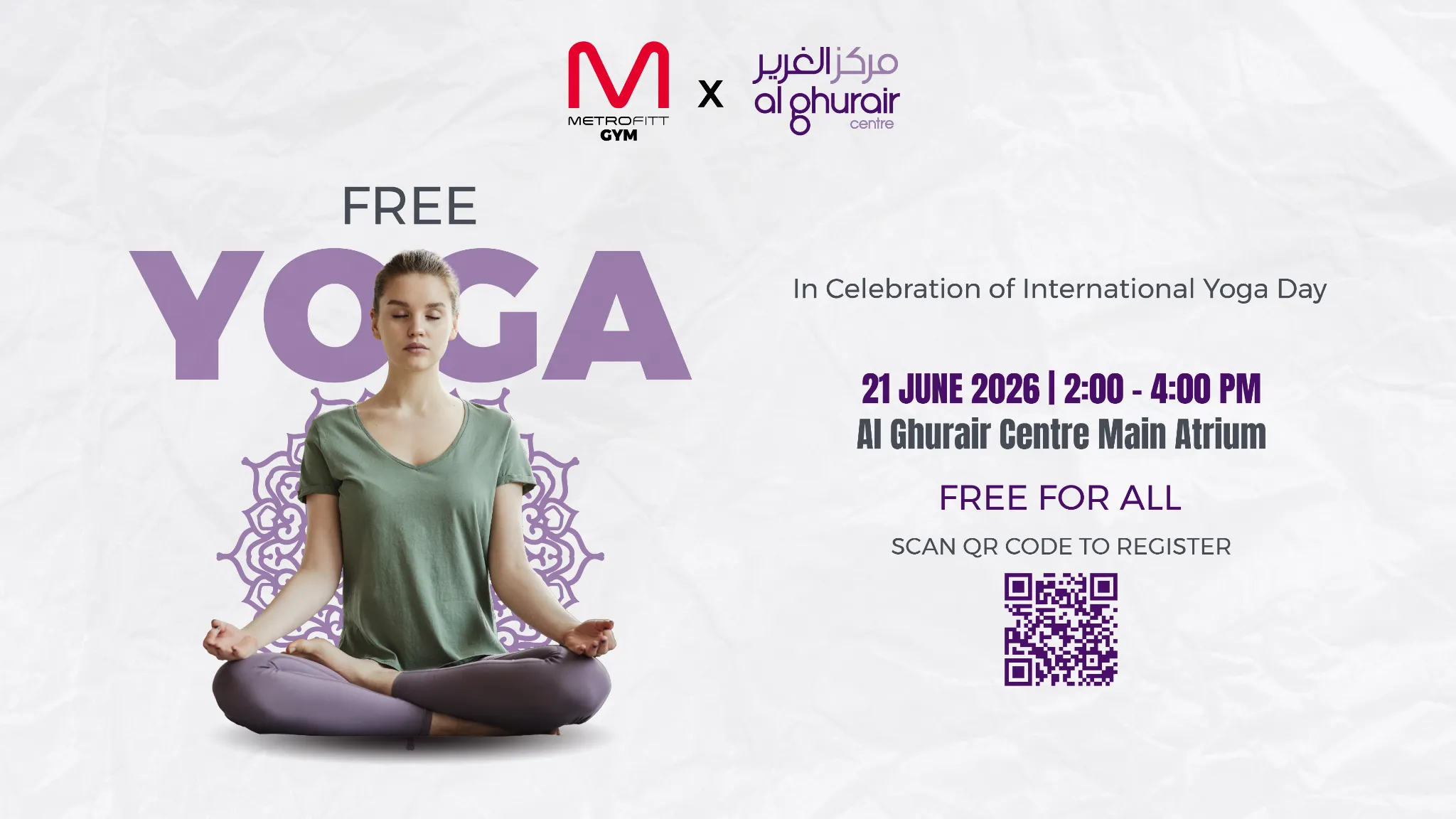
Dubai's wellness scene is evolving at a pace that mirrors the city itself fast, ambitious, and deeply intentional. More residents are trading a purely performance-based gym approach for something more balanced: a practice that builds strength, sharpens the mind, and cultivates the kind of resilience that no treadmill alone can produce. That practice is yoga, and on 21 June 2026, METROFITT is bringing Dubai together to celebrate it.
In partnership with Al Ghurair Centre, METROFITT is hosting a free, community-open International Yoga Day event that welcomes everyone from first-timers who have never stepped on a mat, to seasoned practitioners looking to connect with a like-minded community. No experience required. No membership needed. Just show up.
What Is International Yoga Day?
Every year on 21 June, more than 190 countries mark International Yoga Day a moment established by the United Nations in 2014 to recognise yoga as a universal practice for physical and mental wellbeing. The date is the summer solstice, the longest day of the year, chosen deliberately. It is a day about presence, not performance.
In Dubai, International Yoga Day has grown into something genuine. Not a PR exercise, but a real moment when thousands of residents step away from routine and try something different. Beaches, parks, rooftops, and now METROFITT at Al Ghurair Centre.
Why Yoga Is Growing Fast in Dubai
Dubai is one of the most productive cities on the planet. It is also one of the most demanding. Long working hours, screen-heavy routines, sedentary commutes, and the psychological weight of high-performance environments have created a population that is physically active on the surface but chronically stressed underneath.
Yoga speaks directly to that gap. Not by offering an escape from it, but by building the physiological and mental toolkit to handle it better. That is why demand for yoga classes in Dubai has accelerated in recent years not just among wellness enthusiasts, but among gym regulars, athletes, and corporate professionals who have hit the ceiling of what intensity alone can deliver.
A generation of Dubai fitness enthusiasts trained hard, got stronger, and eventually found the ceiling of intensity without recovery. Yoga is what fills that gap. The question stopped being "is yoga for me?" and became "why did I wait this long?"
The scientific literature on yoga has become substantial. What follows is an honest account of what consistent practice delivers — and what it does not.
Regular yoga builds flexibility, joint mobility, core strength, and postural alignment. It reduces stress hormones, improves sleep quality, and supports recovery between high-intensity training sessions. The mental benefits focus, stress tolerance, emotional regulation are often the most transformative aspect of long-term practice.
Yoga systematically lengthens connective tissue and improves range of motion across major joints. The stiffness that accumulates through desk work and heavy training responds well to consistent practice.
Unlike passive stretching, yoga builds active mobility strength through range of motion. This translates directly to better movement quality in sport and daily life.
Pranayama (breathwork) and mindful movement activate the parasympathetic nervous system, reducing cortisol and creating measurable reductions in perceived stress over time.
Yoga accelerates recovery between training sessions by promoting circulation, reducing muscle adhesion, and addressing the compensatory patterns that lead to overuse injury.
Targeted work on thoracic mobility, hip flexors, and posterior chain activation counteracts the imbalances created by hours of sitting and screen-based work.
Evening and restorative yoga practice has been associated with improved sleep onset and duration, particularly in individuals with stress-related sleep disruption.
The version of yoga that lives on social media is not the version most beginners encounter. Forget the advanced inversions. Forget the idea that you need to be flexible to start — that is like saying you need to be fit before you join a gym. You come as you are. The practice meets you there.
No prior experience, flexibility, or fitness level is needed to start yoga. Most classes offer modifications for every pose. The goal of a beginner session is exposure, not performance. Consistency matters far more than getting poses right on day one.
A typical beginner class lasts 45 to 75 minutes. The structure is consistent: a warm-up phase, a working sequence of standing, seated, and floor-based poses, and a closing relaxation called Savasana — a guided rest that allows the body to integrate the session's work.
- Wear comfortable, stretchy clothing that allows full range of movement
- Bring a water bottle and a yoga mat if you have one mats are usually available
- Arrive a few minutes early to settle in and speak to your instructor
- Tell your instructor if you have any injuries before class
- Take every modification offered there is no beginner shame in this practice
The gym builds the body.
Yoga builds the system that allows the body to keep improving.
Yoga is not a single style. It spans a wide range of approaches, each with a different pace, emphasis, and physical demand. Understanding the main categories helps you find a starting point that matches your goals.
The foundational style. Individual poses held with attention to alignment and breath. Slower paced and methodical — the right place to build the vocabulary of yoga before anything else.
A continuous, breath-linked flow. Vinyasa builds cardiovascular endurance and dynamic strength. Physically more demanding than Hatha — the style many gym-goers gravitate toward.
Poses held for 3–5 minutes or longer, targeting deeper connective tissue. Exceptionally complementary to athletes and strength trainers who need more than static stretching.
An athletic, high-intensity approach that builds muscular endurance and challenges both body and mind. Often the preferred entry point for performance-focused athletes.
Supported passive poses held for extended periods. The goal is complete physical and mental relaxation — ideal after high-intensity blocks or periods of elevated stress.
Yoga vs Traditional Gym Training
Yoga and gym training are not competing for the same role — they are addressing different gaps in the same body. The question is not which one to do, but how to combine them intelligently.
| Factor | Yoga | Gym Training | Combined |
|---|---|---|---|
| Strength | Functional / Isometric | Excellent | Maximum |
| Flexibility | Excellent | Limited | Excellent |
| Cardiovascular | Moderate (Vinyasa/Power) | Excellent | Maximum |
| Stress Reduction | Excellent | Moderate | Excellent |
| Joint Mobility | Excellent | Limited | Excellent |
| Injury Prevention | High | Moderate | High |
| Recovery Support | Excellent | Not Applicable | Excellent |
| Mental Health | Excellent | Good | Maximum |
| Body Composition | Moderate | Excellent | Maximum |
The gym builds the body.
Yoga builds the system that allows the body to keep improving.
The gym-goers who deliver the best long-term results are the ones who train smart, not just hard. Yoga is not a replacement for the gym — it is what makes your gym training sustainable for decades.
Yes, but the mechanism is more interesting than the calorie-burn headline suggests.
Active yoga styles — Vinyasa, Power Yoga — are genuine cardiovascular and muscular workouts. A 60-minute Power Yoga class with a skilled instructor is, for most participants, one of the more demanding things they will do all week.
Chronic stress elevates cortisol. Elevated cortisol promotes fat storage — particularly visceral fat — disrupts sleep, increases appetite for calorie-dense food, and undermines the ability to make consistent healthy choices. Yoga that genuinely reduces stress does more for long-term body composition than its calorie burn alone suggests.
Intensity builds fitness.
Recovery makes it last.
Yoga for Office Workers in Dubai
Dubai's professional workforce is physically active in many respects — but structurally, desk work does significant damage. Prolonged sitting tightens hip flexors, rounds the thoracic spine, weakens the posterior chain, and leaves the nervous system in a state of low-grade activation that never fully resolves.
Compressed hip flexors. Rounded upper back. Forward head posture. Weak glutes. A nervous system that never switches off. Eight hours a day, five days a week, compounding over years.
Targeted sequences for hip opening, thoracic extension, shoulder mobility, and core stabilisation directly counteract these patterns — while breathwork genuinely downregulates the stress response.
- Relieves chronic lower back pain caused by prolonged sitting
- Reduces neck and shoulder tension from forward-head screen posture
- Restores hip mobility and spinal rotation lost through sedentary behaviour
- Builds mental focus and cognitive clarity for complex work tasks
- Provides structured decompression from professional stress
- Improves energy levels through better oxygenation and circulation
- Supports healthier sleep, improving cognitive performance across the working week
Why Community Yoga Events Matter
Practising yoga alone has real value. Practising it alongside hundreds of other people in a shared public space creates something qualitatively different — a collective intention that is difficult to manufacture and impossible to replicate on a screen.
When the City Commits to a Wellness Moment, Thousands Show Up.
The Dubai Fitness Challenge demonstrated year after year that when Dubai commits to a wellness moment, tens of thousands of residents participate. International Yoga Day deserves that same energy. METROFITT is bringing it to Al Ghurair Centre on 21 June 2026.
Here is everything you need to know. Spaces are limited and filling fast. Register early to secure your spot.
A guided community yoga session led by METROFITT instructors. Two hours designed to be accessible to everyone in the room — regardless of experience, fitness level, or flexibility.
A gentle opening sequence to mobilise the joints and prepare the nervous system. No experience needed — your instructor guides every step.
A flowing sequence accessible to complete beginners, with modifications offered throughout. You work at your own pace — there are no wrong poses.
Dedicated pranayama and mindfulness segments. The breathing techniques you learn here are ones you will use every day long after the event.
A guided Savasana to close the session — allowing the body and mind to integrate everything. You will leave feeling genuinely different from when you arrived.
Who Should Come
- Complete beginners who have never stepped on a mat and want a low-pressure first experience
- Gym-goers curious about how yoga complements strength and functional training
- Office workers who need genuine stress relief and physical recovery built into their week
- Existing METROFITT members exploring the full scope of what group exercise offers
- Families, couples, and friends looking for a shared wellness experience
- Anyone in Dubai who wants to be part of a global moment in a local community setting
This event is a no-obligation way to experience METROFITT's approach to yoga before joining a class timetable. Register free, show up on 21 June, and see what the practice feels like in a coached environment.
Dubai, Let's Move.
Spaces are limited and filling fast. Register free today and be part of Dubai's biggest International Yoga Day celebration.