HOW TO LOSE WEIGHT IN DUBAI: A REALISTIC 12-WEEK PLAN

Most weight loss content is written for nobody in particular. A generic person, living a generic life, with a generic schedule and an unlimited ability to meal prep on Sundays and go for morning runs before work. You are not that person. You live in Dubai. And learning how to lose weight in Dubai requires a fundamentally different approach.
That means you work hours that most weight loss plans do not account for. You eat out more than the plan assumes. You cannot run outside from May to September without it becoming a medical event. Your phone has four delivery apps on the home screen. And you have probably tried to lose weight before with reasonable information and genuinely good intentions and found that the plan fell apart somewhere around week three when real life arrived and did not care about your targets.
This plan is different because it is built around that reality rather than against it. Twelve weeks. Three phases. Practical nutrition principles instead of a rigid meal plan. A training structure you can actually maintain. And honest expectations about what the end of those twelve weeks will look like for weight loss in Dubai. No generic tips. An actual plan for the city you are actually living in.
Why Losing Weight in Dubai Is Different — And What Actually Works
Before the plan, the reality. Dubai creates three specific obstacles that most weight loss content never acknowledges. Understanding them is half the work.
The Climate.
From roughly April to October, outdoor training in Dubai is not a realistic daily option for most people. Temperatures regularly exceed 40 degrees Celsius, humidity compounds that, and training outdoors in those conditions is a health risk rather than a fitness strategy. Generic weight loss plans that assume walking, running, or cycling as your primary calorie-burning activity simply do not apply here for six months of the year. Any realistic plan for how to lose weight in Dubai needs to work inside air conditioning, and this one does.
The Work Culture.
Dubai runs late. Meetings extend into evenings. Client dinners happen at 9pm. Long commutes eat into the margins of the day where exercise is supposed to live. A plan that requires you to train at 6am five days a week and prepare all your meals in advance will work until the first busy week arrives and then it will not. The plan needs to be durable under pressure, not just functional when everything goes to schedule.
The Food Environment.
Dubai has one of the most abundant food delivery ecosystems in the world. Every cuisine, available within thirty minutes, at any hour. Portions are generous. Social life is built around restaurants and brunches. Nutritional awareness is harder to maintain here than in cities where eating out is less embedded in the culture. The plan needs to work with this environment, not pretend it does not exist.
A sustainable, healthy rate of fat loss is between 0.5 and 1 kilogram per week. That is the range that preserves muscle, maintains energy, and produces results that last.
What Realistic Weight Loss Actually Looks LikE
Before you begin, reset the expectations. This is not a pessimistic note, it is the most important section in the plan, because unrealistic expectations are the most reliable predictor of failure.
A sustainable, healthy rate of fat loss is between 0.5 and 1 kilogram per week. That is the range that preserves muscle, maintains energy, and produces results that last. Anyone promising faster than this on a consistent basis is either asking you to lose muscle alongside fat, or operating on an approach that is not sustainable beyond a few weeks.
At 0.5 to 1 kilogram per week, twelve weeks of consistent effort produces between 6 and 12 kilograms of fat loss. That is a meaningful, visible physical change for almost anyone. It is also achievable without extreme restriction, without training twice a day, and without turning your entire life over to the programme.
The other thing realistic weight loss looks like is non-linear. You will have weeks where the scale does not move despite doing everything right. You will have weeks where it drops more than expected. Water retention, muscle gain, hormonal fluctuation, and sleep quality all affect what the number says on any given morning. Measure progress across weeks and months, not days. Understanding these timelines is essential when planning how to lose weight in Dubai sustainably.
THE MISSING SECTION: YOUR 3-PHASE PLAN
Phase 1 (Weeks 1-4): Foundation building with 3x weekly training. Phase 2 (Weeks 5-8): Intensity increase to 4x weekly. Phase 3 (Weeks 9-12): Optimization phase at 4-5x weekly. Each phase includes specific training protocols, nutrition focuses, and progress benchmarks.
The 12-Week Plan
Three phases. Each one builds on the last. Consistency across all three produces results that isolated effort cannot.
Build the Foundation
Build the Momentum
Build the Results

Group classes at METROFITT create accountability and structure two of the most important factors for consistency in Dubai’s demanding environment.
Nutrition for Weight Loss in Dubai: Three Principles That Actually Work
This plan does not come with a meal plan. A specific meal plan that does not account for your food preferences, your schedule, your social life, or the reality of eating in Dubai will be abandoned by week two. Instead, three principles that work in the context of Dubai life and deliver the nutritional foundation the 12-week plan requires.
Caloric awareness without obsession
You do not need to track every gram of food you eat. You do need a working understanding of roughly how much you are consuming relative to what your body needs. Learn which meals from your regular delivery and restaurant rotation are high-calorie and which are not.
Protein as the anchor
Protein manages hunger, preserves muscle during fat loss, and keeps energy stable across the day. Make it the non-negotiable component of every meal eggs, chicken, fish, legumes, Greek yoghurt and let the rest of the meal fill in around it.
Hydration as a non-negotiable
In Dubai's climate, the standard advice of eight glasses per day is not sufficient. Aim for a minimum of three litres daily, more during summer and on training days. Dehydration distorts hunger signals and slows recovery.
How to Stay Consistent with Weight Loss in Dubai: Why Most Plans Fail
Information is not the problem. Almost everyone who has tried and failed to lose weight in Dubai knew what they needed to do. The failure point is almost always consistency and consistency in Dubai has specific enemies
Irregular hours make fixed training schedules fragile. A 7am gym session that works beautifully in January collapses when a project runs late in March and you have not slept properly in four days. A gym that is only accessible near your apartment stops being practical the moment work keeps you on the other side of the city three evenings a week. A plan that requires you to be in perfect circumstances to execute it will not survive contact with real Dubai life for long.
Three structures consistently support training habit in Dubai specifically. The first is multi-location gym access when your membership works at any METROFITT club across Dubai, the decision to train is no longer contingent on your geography that day. You train where you are. The second is group class scheduling a booked class creates external accountability that an open gym floor does not. You are significantly less likely to skip a session you have already committed to than one you planned to do independently. The third is a coaching environment a certified trainer, even engaged infrequently, provides progression structure and accountability that most self-directed training lacks.
METROFITT is built around all three. Multiple Dubai locations. A group class timetable across formats. Certified personal trainers available across clubs. These are not features to market they are the structural answers to the specific reasons most Dubai weight loss plans fail.
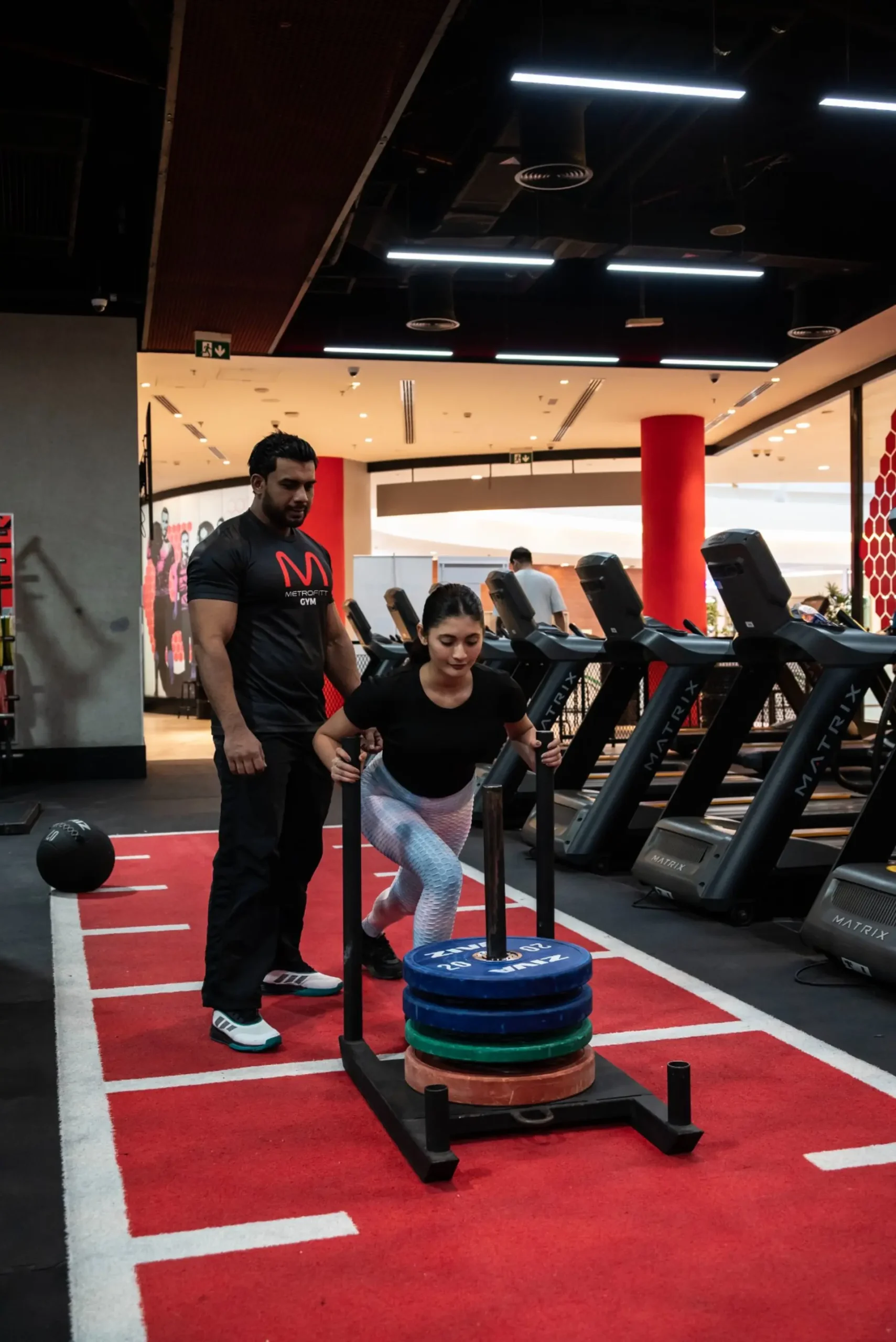
One-on-one coaching ensures proper progression and form, reducing injury risk and accelerating results through personalized programming.
FAQ: Losing Weight in Dubai
How much weight can I realistically lose in 12 weeks in Dubai?
Between 5 and 8 kilograms of fat loss is achievable in 12 weeks for most people following a consistent training and nutrition plan. The exact figure depends on your starting point, how closely you follow the programme, and individual metabolic factors. Sustainable fat loss of 0.5 to 1kg per week is the target faster than this typically involves muscle loss rather than pure fat reduction.
Can I lose weight in Dubai without going outdoors in the heat?
Yes, and for most of the year in Dubai, indoor training is the more practical and safer option. A gym-based training programme across strength work and group classes provides more than sufficient training stimulus for significant fat loss without any outdoor component. The 12-week plan above is designed entirely around indoor training.
How many times a week should I train to lose weight?
Three sessions per week is the minimum effective dose for meaningful fat loss progress. Four to five sessions per week, as introduced in Phases 2 and 3 of this plan, accelerates results while remaining sustainable for most working professionals. Consistency across a moderate frequency outperforms intensity at a frequency you cannot maintain.
Is diet or exercise more important for weight loss?
Nutrition drives the majority of fat loss results roughly 70 to 80 percent of the outcome. Exercise is essential for preserving muscle, improving body composition, accelerating caloric expenditure, and delivering the fitness and energy benefits that make the process sustainable. Neither works as well without the other, but if you can only control one variable, nutrition has the greater direct impact on the number.
What is the best type of exercise for weight loss in Dubai?
A combination of strength training and cardiovascular conditioning delivers the best results for body composition and sustainable fat loss. Strength training builds and preserves lean muscle, which increases resting metabolic rate over time. Conditioning work group classes, HIIT, circuit training — accelerates caloric expenditure and improves cardiovascular health. Both are available across METROFITT's class and training floor offering.
How do I stay consistent with a gym routine in Dubai?
Three things consistently support gym habit in Dubai: multi-location membership so training is not tied to one geography, group class scheduling that creates external accountability, and access to coaching that provides progression structure. Building your routine around these three factors removes the most common friction points that derail consistency in Dubai's demanding environment.
START YOUR 12 WEEKS
AT METROFITT
The plan is here. The environment to execute it is at METROFITT across multiple locations in Dubai and Abu Dhabi, with the equipment, the classes, the coaching, and the multi-club access that makes consistency achievable.